

Bilsdale transmitter
Bilsdale transmitter page jump links :
- Digital power output, aerial group and polarisation of Bilsdale transmitter
- Our TV aerial recommendations for Bilsdale
- Bilsdale's graph (its transmissions v our aerial recommendations)
- Bilsdale's channels/frequencies (including alternative transmitters)
- Bilsdale transmitter's 2021 fire
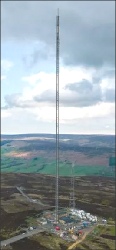
The replacement Bilsdale (full height : 306m) transmitter began transmissions on the 22 May 2023.
Note the 78m "interim" tower is still in situ (to the right of the brand new full height mast) at the time of this photograph.
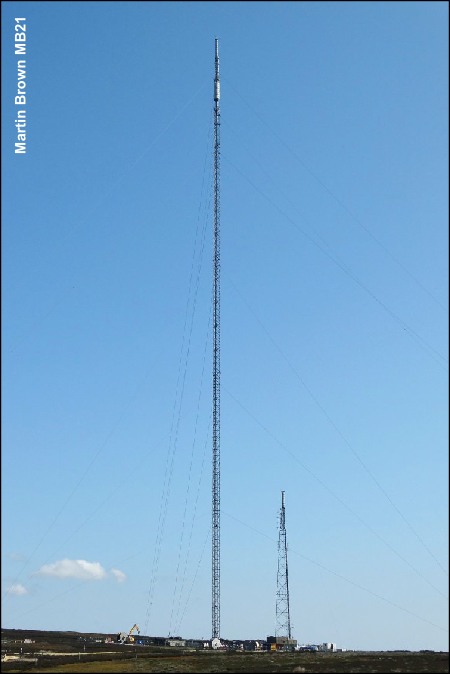
The current Bilsdale television transmitter is a guyed mast (space frame type) of 306m height and began transmissions on the 22 May 2023. It was built as rapidly as possible to replace the previous transmitter which was seriously damaged in a fire in Aug 2021, see article below.
The original 1969 (309m) mast was also guyed but was of tubular construction. It was identical to Waltham and Mendip, though it was built by JL Eves (now Babcock) whilst the other two were constructed by BICC (now Balfour Beatty). The Bilsdale mast was a tubular structure all the way to the top (unlike Winter Hill) and had in internal lift, though this was out of use after 1995 following the accident at Belmont. The transmitter was originally owned by the BBC before being sold off to Crown Castle (Castle Transmission International - CTI) then to National Grid Wireless and finally to Arquiva (sic).
The transmitter site is about 15 miles SSE of Middlesborough, it can be seen from the A1 on a clear day. As one travels North it's on the right. A slightly better view can be had from the railway line (between York and Darlington) as it is a little closer, perhaps 12 miles away. The A19 from the A1 up to Teeside passes closer still.
Due to the fact the 306m mast (see How High is High ? ) was built on a 376m mountain the overall aerial height/altitude is 682m (2250ft) and unsurprisingly this is one of the highest in Great Britain. The latter fact obviously helped its transmission range, but like all transmissions they are subject to the "line of sight" rule, even with a "high gain" aerial !
Bilsdale's population coverage is around a million. Many of those in York, Darlington, Stockton, Middlesborough, Hartlepool, Sunderland and Harrogate use Bilsdale's transmissions, though it can also be received at sites on high ground in Sheffield, that's 70 odd miles away!
Bilsdale transmitter's channels
For the most up to date MUX to channel allocations etc put this postcode TS9 7JS into the Freeview checker.
Also see Tyne Tees region Freeview transmitters.
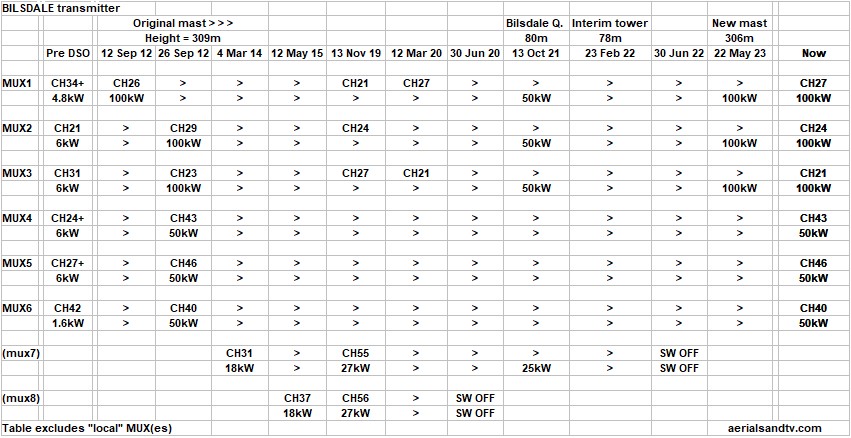
Bilsdale puts out up to 100kW of digital power which makes it the 13th most powerful transmitter. Note the huge increase in power at the 2012 digital switchover.
Bilsdale is horizontally polarised was originally an A group for its analogue output but only 3 (the PSBs) of the 6 main digital MUXES can still be received with a group A aerial. MUXES 4 to 6 are out of band so most people would have to change their aerial (to a K group or wideband).
The transmitter has fifteen smaller relays (or repeaters) to improve coverage in poor reception areas within its coverage area.
There is one "Local" channel allocated to Bilsdale, CH30, mainly for a local Middlesborough TV station. This is within the K group.
For Bilsdale we recommend the Yagi10K for strong signal areas, the Log36 for medium signal areas, and the Yagi18K or XB10K for poor signal areas, the latter aerial being particularly well suited to loft mounting. The XB16K is for those with the most marginal signals. The dimensions and test performance of the aerials are on the relevant buy pages.
Because of wideband antennas poor response at the bottom of the band, anyone who really requires a “high gain” aerial on a K group transmitter (e.g. Bilsdale) should actually fit a K group ! See Bilsdale transmitter’s graph.
But not that many people actually need a high gain aerial anyway........
Bilsdale transmitter : the 2021 fire
Timeline
10 Aug 21 - Bilsdale transmitter (309m high) seriously damaged by fire
6 Oct 21 - Mast demolished by controlled explosion
13 Oct 21 - Temporary (80m) transmitter erected at a nearby quarry : "Bilsdale Quarry" transmitter
23 Feb 22 - More substantial "Interim" transmitter (78m) into operation on the site of the original TX
22 May 23 - Replacement full height (306m) mast into operation
For the powers of these transmitters see above article
MB21 Bilsdale transmitter fire
Video of the fire damaged mast being demolished
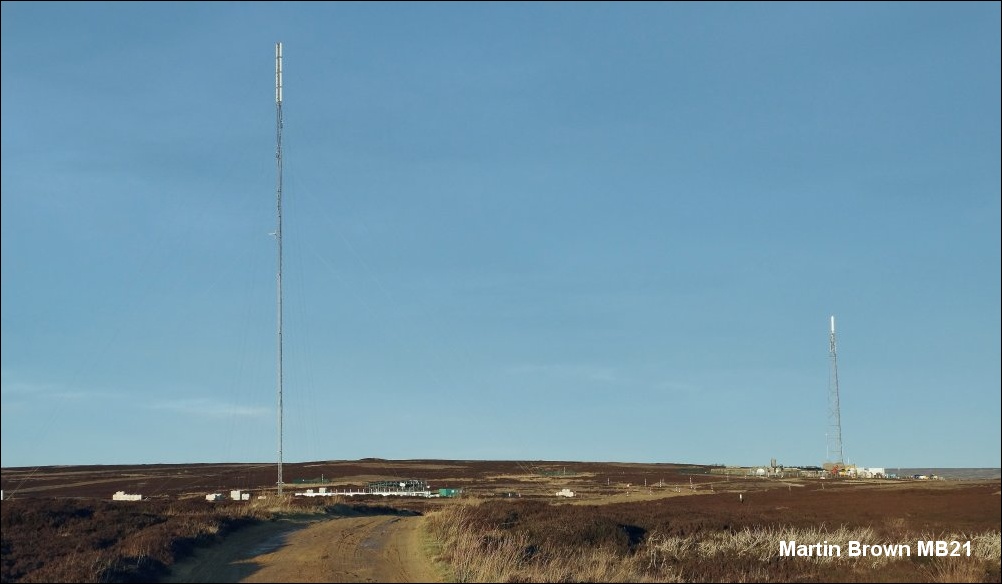
Picture taken on the 12th Jan 2022, on the left we have the temporary Bilsdale Quarry transmitter, and on the right is the Bilsdale "interim" transmitter tower.
Picture Martin Brown MB21 Jan 22
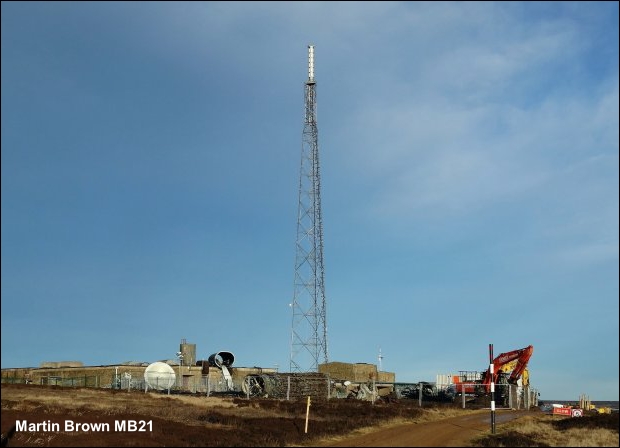
2nd picture from the 12 Jan 22 with a closer shot of the Bilsdale "interim" transmitter tower. It was built on the site of the original mast and it went into service on the 23 Feb 22
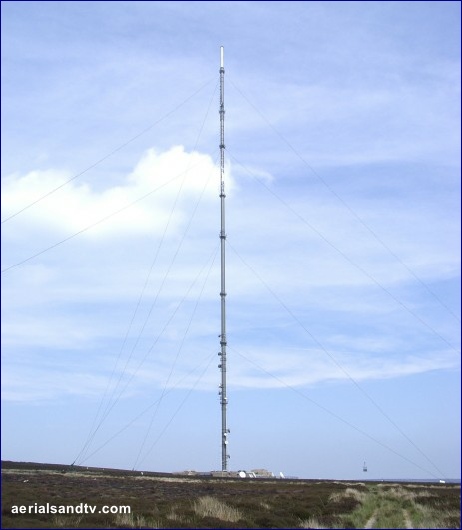
The original Bilsdale television transmitter from the moor below it. Note the repainting in progress (it certainly seemed to need it !) and the “Bosun’s Chair” being used to ascend the mast, see below.
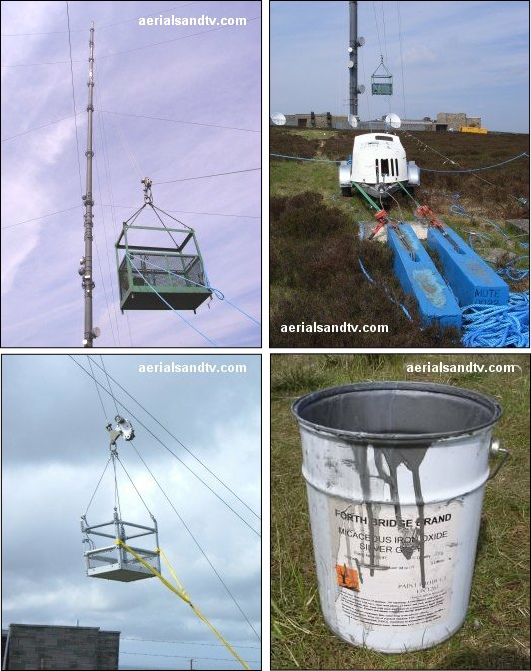
“Bosun’s Chair” being used to access the original Bilsdale mast whilst it was being repainted in June 2007. Above the right is the winch (and its anchors ! ) to hoist the “chair” up as required. Below (left) is the same system being used on Redruth (in 2005) and on the right the type of paint used to coat the structures. The masts are galvanised with a 25 year warranty against rust, after that time they’re repainted every 10 years with etching primer then Micaceous Iron Oxide on top of that.
And we all love the Forth Rail Bridge don’t we, I know ATV do !
Bilsdale transmitter : External links
Bilsdale page at MB21
Bilsdale Transmitter page at The Big Tower
Bilsdale Transmitter page on Wikipedia
Bilsdale transmitter : graph of its transmissions against the gain curves of the aerials we recommend for it
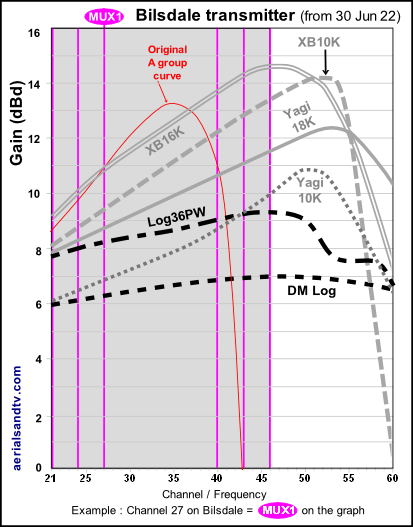
Bilsdale's channels from June 2022 in relation to the UHF TV band and the gain curves of the aerials we recommend for it.
Yagi10K Log36 Yagi 18K XB10K XB16K
Note the channels out of the original A group of the transmitter, the PSBs are within the A group though. Also see other relevant K group curves.
Bilsdale Channel Allocations
For the most up to date MUX to channel allocations etc put this postcode TS9 7JS into the DUK checker.
Also see DUK Tyne Tees region transmitters.
The table below includes the same information for Pontop Pike, Chatton, Fenham, Emley Moor, Keighley, Belmont and Oliver's Mount. All these transmitters are receivable within Bilsdale's coverage area and this information can be very useful for identifying alternative transmitters. The channel allocation guides can be very useful in the diagnosis of co-channel interference problems and can also be invaluable if you are trying to find a spare channel for a modulated output (e.g. for a Sky box or CCTV system) to be added to your TV setup/distribution system without suffering from co-channel. Note how most of the channels from all the transmitters neatly "dovetail" with each other. Also check Bilsdale's fifteen smaller relays.
The frequencies given are for (most) digital MUXES, for analogue channels deduct 3MHz.