
Heathfield Transmitter
Note, due to the new phenomenon of MUXICAL chairs you may experience problems with certain MUXES disappearing. First try rescanning your TV / set top box, do it manually if possible. If this fails to sort it check on transmitter work or call the reception advice phone numbers.
Also see basic digital fault finding.
700MHz clearance occurred at Heathfield on the 18 Jul 2018 when it stayed a B group.
Heathfield transmitter page jump links :
- Digital power output, aerial group and polarisation of Heathfield transmitter
- Our TV aerial recommendations for Heathfield
- Heathfield’s graph (its transmissions v our aerial recommendations)
- Heathfield's channels/frequencies (including alternative transmitters)
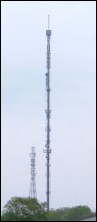
Heathfield transmitter was opened in 1969 and is located 13 miles NNW of Eastbourne. The top of the mast is 998ft (302m) from sea level and the total mast height is 145m, though the height to the bottom of the antenna shroud is 135m, see How High is High ?
Heathfield’s population coverage is around 500 thousand and it has sixteen (including Hastings) smaller repeaters off it to improve its signal coverage in poor areas.
Heathfield transmitter : digital power and channels (historical and present)
For the most up to date MUX to channel allocations etc put this postcode TN21 0UG into the Freeview checker.
Also see Meridian region Freeview transmitters.
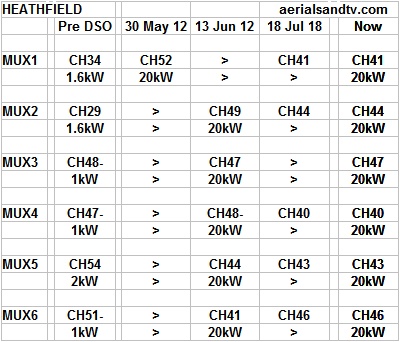
Note the big increase in power after the 2012 digital switchover.
Heathfield is a B group though originally (for analogue) it was a C/D group. However, C/D group aerials often pick up signal quite well below their designed for band, reception of all the digital is often still possible on an original "C/D analogue group" aerial (see Heathfield’s graph). This may not apply to some cheap crappy Contract aerials.
Being a main transmitter Heathfield is horizontally polarised.
Heathfield has an omnidirectional transmitter radiation pattern and operates as a single frequency network with Tunbridge Wells transmitter.
For Heathfield transmitter we recommend the DM log or Yagi10K for strong signal areas, the Log36 or Yagi18K for medium signal areas, the Yagi18B for outdoor installs in poor signal areas, the XB10B for loft installations in poor signal areas, and the XB16B for those with the most marginal signals. Unless you have a massive loft we’d normally recommend an XB10B for loft installs (over an XB16) due to smaller size of the former aerial. The dimensions and test performance of the aerials can be found on the relevant buy pages.
External Links
Heathfield page on MB21
Heathfield page on Wikipedia
Heathfield on The Big Tower
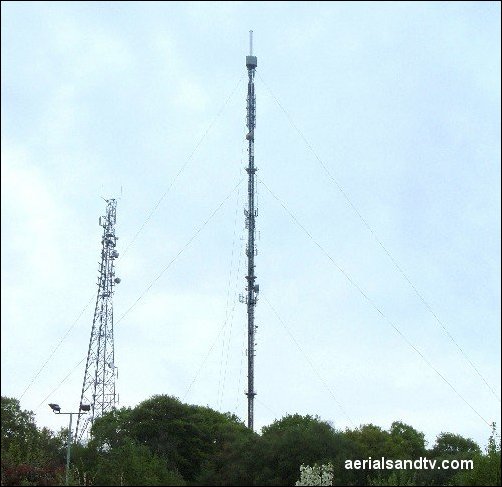
Heathfield television transmitter
Heathfield transmitter : graph of its transmissions against the gain curves of the aerials we recommend for it
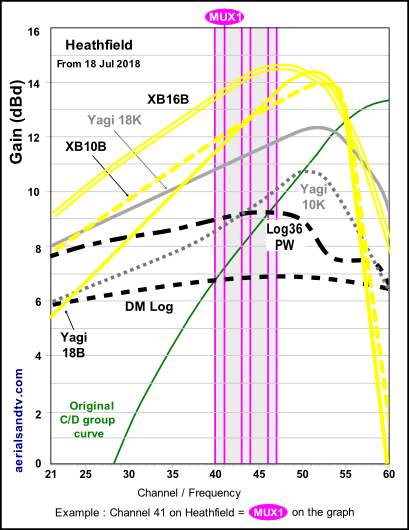
Heathfield’s channels in relation to the UHF TV band and the gain curves of the aerials we recommend for it.
After the switchover in 2012 Heathfield became a B group (as opposed to its original C/D group). Thus four of the six MUXES are technically out of the original C/D group. But the graph shows quite clearly that the “cut off” for C/D group aerials is not precipitous and that most people in reasonable signal areas will get all the Digital OK off their “old” C/D group aerial, particularly as the power was increased at the 2012 DSO by a large margin. Though this may not apply to some cheap crappy Contract aerials.
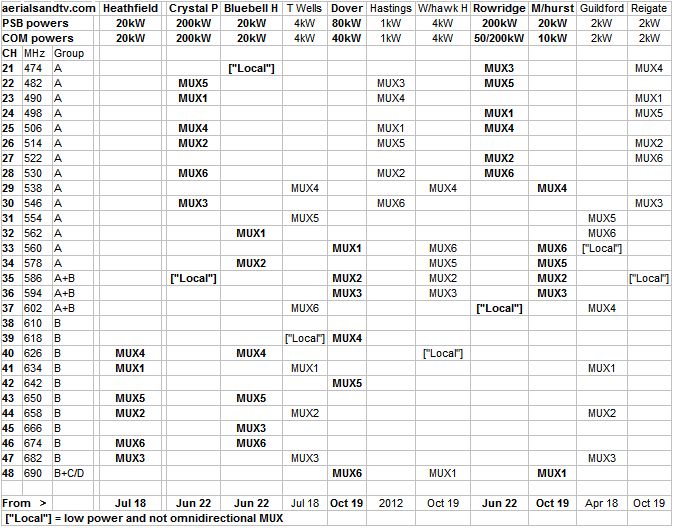
Heathfield transmitter's channel allocations
For the most up to date MUX to channel allocations etc put this postcode TN21 0UG into the Freeview checker.
Also see Meridian region Freeview transmitters.
The channel allocation guide below also includes the same information for other potentially co-receiveable transmitters, this also include the frequencies for Crystal Palace, Bluebell Hill, Tunbridge Wells, Dover, Hastings, Whitehawk Hill (Brighton), Rowridge, Midhurst, Guildford and Reigate. This data can be very useful for identifying other transmitter options, see importance of "line of sight". The channel allocation guides can also be very useful in the diagnosis of co-channel interference problems and can also be invaluable if you are trying to find a spare channel for a modulated output (e.g. for a Sky box or CCTV system) to be added to your TV setup/distribution system without suffering from co-channel.
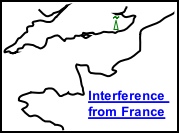
Note the various co-channel issues, and that’s before one brings in the continental transmitters ! Also check Heathfield’s sixteen (including Hastings) smaller repeaters.
The frequencies given are for (most) digital MUXES, for analogue channels deduct 3MHz.