

Aerials for caravans and boats
(also see FM / DAB aerials)
Subject list :
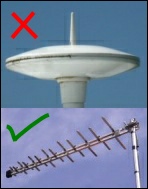
- The problems of Caravan / Boat TV reception
- Aerial recommendations for Caravan & Boats incl:
- - Omnidirectional TV aerials (not recommended)
- - DM Log : the best caravan / touring aerial
- Why do people use Yagi aerials as caravan or boat aerials ?
- DM Log v Omnidirectional aerial
- DM Log v "set top" aerial
- Don’t forget your cable
- Maximising your TV signal on a Caravan / Boat
- How high to mount your caravan / boat aerial
- Post Switchover Post Scripts
- Mounting aerials on boats and caravans
- Satellite v aerial for caravan / boat TV
- Tests of commonly used caravan / boat aerials
- - incl : What’s inside a Status TV aerial !
The Particular Problems of Boat / Caravan TV Reception
Since any aerial used for reception on a boat or caravan is usually required to work at different locations it is a given that a wideband aerial is required, these have disadvantages in poor signal locations (compared with a grouped aerial), but I use a DM Log ( a relatively low gain wideband aerial) when boating and can get it to work fine in well over 90% of locations. The need for a wideband aerial, it must be admitted, is the least of the problems a boater, or caravanner, has. Many sites are in poor locations (especially for boaters as waterways tend to be in valleys, see importance of line of sight) and furthermore space, for storage of the aerial, is usually at a premium on a boat or in a caravan, so an aerial of large physical size is problematic. Unfortunately, as a general rule, larger aerials give more gain (i.e. more signal) and smaller aerials give less gain. Just using an aerial amplifier to “boost” the signal from a low gain antenna is unlikely to be effective. I certainly found this to be my general experience, particularly when used with an Omni directional aerial. Lastly touring aerials are going to get battered about and most aerials, particularly budget types, are easily bent and difficult (or impossible) to repair
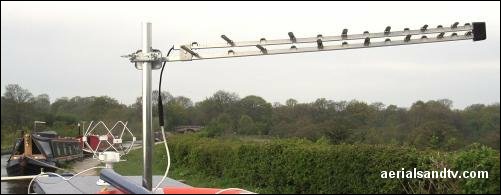
I’ve seen some aerials which are literally falling apart, though, somewhat surprisingly, they’d probably still give a decent picture in good reception areas. The DM Log, pictured alongside, is, on the other hand, robust and easily repairable
Speaking of good reception areas, it is important to understand that the range of possible signal strengths available in this country is HUGE, see the article on signal strength.
The fact a large aerial is out of the question is probably a blessing in disguise, because it is highly doubtful that the mounting for it (on a boat or caravan) would be strong enough to withstand a strong wind anyway ! On the subject of bracketry and poles, that’s another problem, because aerials should be mounted as high as possible (particularly in poor reception locations) and it’s unlikely that the average boat owner / caravan owner wants a 20ft mast bolted to the side of their pride and joy. That said, a lot have satellite dishes, and they’re hardly aesthetically pleasing either, especially on a canal boat......
Actually all of the above is only the start of it, the biggest problem is that getting the best signal involves juggling with not one, not two, but three variables :
1 The direction of the transmitter is the most obvious variable, your aerial must be pointing at it (unless you’re right next to a main transmitter ! ) or your picture will be poor.
2 The tuning of the transmitter(s) which you’re trying to receive. Even if you’re right next to Emley Moor you’ll get “no signal” if your set is not tuned into it !
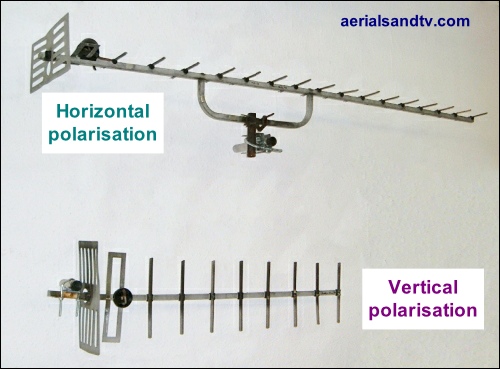
3 The third variable is often overlooked and that is the polarity of the transmitter, vertical or horizontal. If you get the wrong polarity on your aerial you could be losing up to 90% (or more) of your signal, which isn’t to say it won’t still work if the signal strength is high enough, but if it isn’t, well, no Coronation St for you.
Aerial recommendations for boats and caravans
It is possible to eliminate two of the variables mentioned above, namely direction and polarity, by using an omnidirectional or "Omni” aerial. The problem with this strategy is that, how can I put this, Omni’s are crap...... In fact the gain of an Omni is actually negative, theoretically it's minus 3dB, and that's without taking into account the additional loss of an incorrectly polarised aerial ! And, whatever the aerial manufacturers might try to tell you, you CANNOT compensate for that by using an amplifier, and even if you could you'd then have too much signal if you were at a site which could see the transmitter ! Lastly an Omni’s acceptance angle (to eliminate unwanted signals), is, well, 360° !
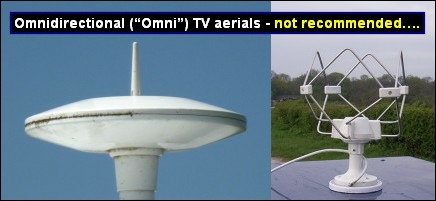
If you get a good picture off an Omni TV aerial it’s because you’re in a good signal area. In fact I reckon that a coat hanger (a metal one, obviously….) would work just as well, actually, it may well work better. The fact is that in a poor signal area an Omni TV aerial is about as much use as a 2nd World War Italian Kamikaze squadron*.
* Many bomber command missions in the last war had appallingly high loss rates (of 5% or more).
The most efficient of the Japanese Kamikaze squadrons had a loss rate of 100%.
The aforementioned Italian Kamikaze squadron had a loss rate of around 0%.
I have always said that Omni directional TV aerials can’t be any good, but that was a theoretical position until we hired a boat which came with one fitted. Much to the annoyance of my wife, I was able to experiment as to the differences between an Omni and the aerial I recommend for touring, a DM Log Periodic or DM18 Log Periodic (as also supplied in our caravan aerial kits), and unsurprisingly the Omni didn’t fare too well. I’m a fan of Log Periodics and this model is particularly well suited to the role of touring. It’s reasonably compact (DM = 3ft 6in long, DM18 = 2ft 6in) bearing in mind that you never get anything for nothing, remember, all things being equal, a shorter aerial will give you less gain / signal and use of an amp (“booster”) does not compensate for this.
DM Log or DM18 Log ? We stock two versions of the DM Log, the standard model and the DM18 Log, the latter so called because it only has 18 elements compared to the 26 of the “standard” DM Log. Thus the DM18 is only 2ft 6in long but, unfortunately, you will pay for that with slightly less gain, though the difference (about 1dB) is not great. On the other hand a DM18, being smaller, is easier to store and also less likely to get damaged.
It’s the only antenna we recommend for boats and caravans.
Why ?
Well it works well, and it's repairable……
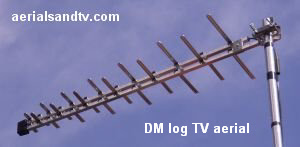
The DM Log is pretty strongly made and because it’s nearly all metal in construction it’s eminently fixable if it gets damaged, as any touring aerial is bound to be...... Furthermore, Log aerials are flat, thus making storage much easier and lowering the risk of the antenna being damaged. At a conservative estimate the gain of the DM Log would be about 6 to 7dBd and since we use it as a control aerial for all our antenna testing its relative gain to all our other aerials can be seen on the relevant graphs, like the one on the buy page for the DM Log. Now it must be admitted that 7dBd is not "high gain", but since all high gain aerials are large, and as such are unsuitable for boats or caravans anyway, I wouldn’t worry about that too much, particularly when, as we’ve just discussed, an Omni has minus 3dB of gain.
So, compared with an Omni TV aerial, a DM Log is high gain !
On the subject of which, we sometimes get asked if a Log36 would be a better choice (for a boat/caravan aerial) than a DM Log because its gain is a bit higher. Well yes and no would be my answer. You do get a bit more signal out of a Log36, but on the other hand the DM Log is 10in shorter, it has a tilting clamp, and, most importantly, it’s more easily fixable if it gets damaged. Once, whilst testing a Log36 aerial, I accidentally bent some of the alloy rod type elements on it, but when I tried to straighten them some just broke off ! We do endeavour to provide spares for all aerials purchased from us but it's much easier if you can just repair your aerial without needing any spares.... So, basically, I’d always recommend the DM Log, and only the DM Log.
Also see :
Maintaining your DM Log
Customer feedback using a DM Log
Use of a cradle with a Log Periodic aerial
We recommend that all Log Periodic aerials are installed slightly tilted up at the front end.
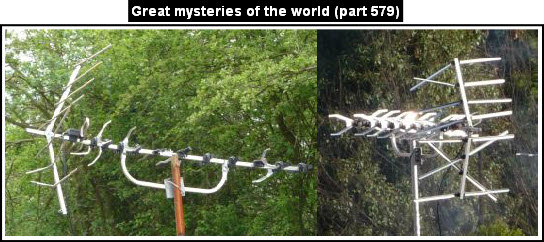
There are many great mysteries in this world of ours, like the Mary Celeste, and why some lazy ignorant drivers put all that effort into winding down their window and throwing their fag end out of it, when it’d actually require less effort to put it in the ashtray........
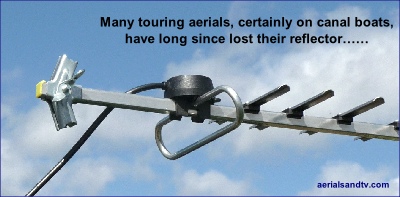
But along with these imponderables must rank why boaters or caravanners use flimsy "Bacofoil" X Beam type aerials like the ones in the above pictures. You see loads in use, in fact a large percentage of the boats I see around seem to have them, but X Beam type aerials are fundamentally unsuited to use as touring aerials. The reflectors mean they take up a lot of room, unlike a flat Log Periodic aerial, and the “Xs” are hardly space saving either. Furthermore the X type directors are often a weak point on even the best of the X beams, but these Bacofoils (usually marketed as SLX, Philex or Labgear) must be the flimsiest aerials ever sold, in fact I’d say they’re only really suitable for use in lofts where there’s no wind, no birds and, hopefully, only small spiders....... When one remembers that touring aerials are usually put up and down every few days, and bashed about generally, the use of Bacofoils becomes even harder to understand.
A Yagi aerial with no reflector is losing almost half its gain. A Log Periodic aerial would perform just as well, in fact if the Yagi aerial was a small one (e.g. an XB5) the Log would definitely perform better……
Cable for boat / caravan aerials
Because the cable runs on boats/caravans are usually pretty short cable quality is not quite as important as it is with aerial installs on houses, but since the price difference is so small anyway it really is a false economy to use cheap crappy cable. “Low Loss” coaxial cable is not recommended, I’d always use decent quality satellite grade lead, preferably copper/copper. It’s not so much for the difference in signal loss (which would be relatively small on the short runs), it’s more for the suppression of impulse noise which can be very annoying with digital pictures. It’s probably an even better idea to go for copper/copper type cable (as opposed to alloy foil RG6) on a boat than it is on a house install because damp might be a problem and copper/copper is less susceptible to corrosion than alloy foil RG6 type cable.
Finally when it comes to cable colour it is often tempting to go for white but remember that it soon gets dirty, so I’d go for black myself !
Maximising Your TV Picture Quality on a Boat / Caravan
Before we go any further, don’t forget the obvious, which way are the other aerials facing/polarised ? And this is likely to be more accurate for any nearby houses (as opposed to other boats or caravans) as they were probably put up by an installer with local knowledge.
Number One > if you want to maximise your TV signal avoid using an Omni directional aerial ! On the other hand, in my opinion, the best aerial for a caravan or canal boat is a DM Log Periodic / DM18 Log and that is the one we use when we hire a boat. Using that aerial we get a signal in around 95% of locations, and that's despite the fact canals and rivers tend to be at the bottom of valleys.......
As we have seen there are three variables to be overcome if one is to get the best possible picture and, apart from local knowledge, there are two ways of achieving this.
The first involves research, knowing where all the transmitters are, their frequencies and what polarity they are. All this information is readily available but requires collating and remembering, or filing somewhere..... Apparently there is a mobile phone App which can help with this, though reception predictors are never 100% accurate.
For locations try our transmitter map or the main digital transmitters map or Ofcom transmitter maps or MB21’s transmitter map page. For frequencies/ polarities try the last two.
Boaters may also find River & Canal transmitters useful. Don’t take the signal strengths at the locations as gospel (signal strength can vary in just yards….) but the transmitters and their directions could be handy to know.
Always bear in mind the over riding importance of “Line Of Sight” to the transmitter, which direction has the fewest hills, high buildings or trees ?
Even with all this info, unless it’s obvious which is the best transmitter to go for, it may require a bit of effort and time when you actually moor up (or park up your caravan) to ensure that you really are getting the best possible signal. It is quite a satisfying achievement though !
If all else fails you could try one of those basic signal strength meters. I have to say I briefly tried one of these (given to me as a freebie), and I found it inconsistent to use as a transmitter finder, I actually found it less trouble to just research where the TXs are ! Anyway most professional installers would laugh at those cheap signal meters because (regardless of any failing they may have in accuracy or sensitivity) they just give one reading for all the received frequencies. However, this means that they’re actually very handy for finding the strongest source of TV signal for a boater or caravanner because they often don’t actually know the frequencies ! Thus, because you don’t need to “tune in” cheapo signal strength meters you eliminate one of the three variables, though don’t forget you still need to check which polarisation is required. So to be sure you’ve covered that particular variable you may have to go through the whole signal finding process twice, once with your aerial horizontally polarised, and again with your aerial vertically polarised.
Note : 4G transmissions can make cheap signal level meters worthless because the 4G signals are within the frequency band which the cheapo meter is looking for. It may report large signals in a particular direction but that might just be a 4G mobile phone mast ! You can get round this by using a filter between the aerial and the meter (we recommend a CH56 / group K+ filter), though meters sold after summer 2013 may have built in filters, so check with your supplier.
Post Switchover Post Scripts
The first trip we took after the (complete) switchover over reminded me very clearly how finding the best digital signal is so much harder then finding the best analogue signal was. The main problem is that the digital signal is either there or it isn’t, though there is a narrow band of signal quality when the picture’s there but it’s breaking up and freezing all the time.
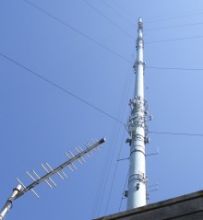
The first night we were moored at Claverton (visit the pumping station, very interesting) on the Kennet & Avon canal. We were right in a valley and there wasn’t a house nearby so I could check which transmitter it was getting its signal from ! I pressed on, but despite me having the advantage of knowing the direction and polarity all the transmitters even when using the DM Log the TV’s tuner couldn’t find any signal off Mendip, Ridge Hill, Oxford, Hannington, Rowridge, or even the Bath relay. Salisbury did give a bit of a signal but it wasn’t usable. This complete absence of signal has never happened anywhere before (in fact I even suspected the TV was faulty) though I only mount my aerial only about 18" above the boat’s roofline because I don’t have the option to mount a higher pole on a hire boat. Not that I’m saying a higher aerial pole would necessarily have made a significant difference. Obviously, at this site, the boat’s Omni type aerial didn’t find anything at all, even off Salisbury. As an aside were we were moored there were trees all round us so even a satellite would not have worked. Anyway, we stopped at Bathampton the following day which is right next to Bath transmitter and the TV operated satisfactorily there, in fact even the Omni aerial worked in that location ! Of more interest was when we moored at Hilperton. There, even though it was through trees, the DM Log managed to get a reliable signal from off the first transmitter I tried which was Mendip. However when I tried the Omni as an experiment the signal was breaking up all the time.
I’m unconvinced if the TV’s tuner was sufficiently sensitive (they do vary), but even so, TV reception wise, it was a sobering trip. I suspect that with analogue we’d have always got something, even if at Claverton it may well have been grainy and ghosting, but, unfortunately, analogue’s gone........
So, a reminder of the overwhelming importance of signal strength. In some spots you won’t get anything whatever aerial you use, whereas in some spots even an Omni will work. What’s most interesting to me are the areas, like Hilperton, where a decent aerial will get you something, but a crap aerial won’t.
In 2013 we went for a week on the Monmouth & Brecon canal, and what a fabulously scenic canal that is, particularly when the weather’s good, which it was. But it's very shallow, we struggled to do more than about 2mph most of the time ! We were told “you can’t get a signal at most spots, watch DVDs instead”. Well I don’t actually watch that much TV, but I do have an interest in whether it’s possible to get a TV signal ( ! ) and I have to tell you that at all 5 locations I tried it I got a signal using our DM Log, though I did have rather less luck with the Omni fitted on the boat. They’re half right, “you can’t get a signal at most spots with the Omni aerial, watch DVDs instead”….. I’m sure there are locations on the M&B where even a DM Log wouldn’t work, but it did wherever I tried it. You do have to know where the transmitters are though, and the fact they’re all vertically polarised, and, most importantly, don’t use an Omni !
I thought the Norfolk Broads would be all flat, that was how I remembered them from holidays as a kid, but when we went for a short break on them in 2014 I realised it’s not (quite) like that ! Our DM Log worked everywhere we moored to a greater or lesser extent, though it must be admitted the signal at Rockland St Mary wasn’t perfect. At the staithe there the aerial is aligned WSW onto Tacolneston and firing through a load of trees and a hill ! It was just about OK with the odd glitch. The boatyard supplied XB5 aerial (with no reflector….) didn’t work there at all.
Satellite v aerial for caravan / boat TV
You can use a satellite rather than an aerial to receive your signals, though you’ll usually require a separate satellite set top box in order to do so, but what are the relative merits of satellite v aerial ? Basically it’s swings and roundabouts. There are places where a satellite will work perfectly and an aerial will only give a poor signal, but on the other hand, there are places (e.g. with trees or buildings in the way) where an aerial will work and a satellite won’t work at all.
Setting up an aerial is usually much easier than a satellite, particularly if there are any houses around, you just point your aerial in the same direction and polarity as theirs, retune your TV, and that’s it, no meter, no fine tuning the dish, nothing. When analogue was switched off the digital signal was greatly increased in power so less problems should be experienced finding a signal, but on the other hand the “old” analogue signal was more reliable in poor signal areas, albeit at poorer picture quality, than the digital one. Unfortunately analogue’s gone..... I accept that there are times when it’s not that simple to get a decent signal from your TV aerial but we regularly get people buying aerials because they find setting up a dish too much hassle. I personally find them too much trouble so we don’t even sell satellite stuff for boats/caravans, but that’s not saying some people won’t find it a viable alternative though you should bear in mind that satellite tuners do tend to increase the current draw from your battery, particularly if it’s a set top box in addition to the TV. One other thing, it’s not unknown for people using satellite dishes on their caravan or motor home to have problems when they go up to Scotland, particularly north Scotland. This is to do with the curvature of the earth and the fact that as you go further north you need a bigger dish to receive the same size signal. This is why the standard Sky dish in England is 43cm, but in Scotland its 60cm. On the subject of dish size, when it comes to satellites, the size of the dish has an important bearing on ease of setting up and the reliability of the received signal. Basically a smaller dish will have a wider acceptance angle than a larger dish. This is good and bad. It’s good because it’s easier to aim it at the satellite and therefore quicker to set up. This may explain how come aerial installers use £300 meters to set up a domestic installation (and take time doing so) when some caravanners/boaters can, apparently, do it in 5 to 10 minutes with a £30 meter ! Furthermore the wider acceptance angle also means that there’s less chance of the signal going off due to movement (e.g. of a boat at its moorings), though this would not normally be a problem in a caravan, unless you’re in an earthquake zone, or your suspension is soft and there are hurricanes about. The down side of a small dish is the quality of the signal can never be as high as with a large dish and less signal means that there’s a greater chance that bad weather will affect your reception (“rain fade”), so, at the end of the day, you pays your money, and you takes your choice.